
Quick Answer
Professionally designed Christmas light displays from Sundance Holiday Lighting start at $1,200 across Salt Lake County and Summit County, and that price covers:
The lower numbers you see online, often a few hundred dollars, usually describe labor-only jobs where you supply and store your own lights. Your final price depends on your roofline, your trees, the design, and how easy your home is to reach.
If you have searched for holiday lighting prices, you have probably seen everything from under $100 to a few thousand dollars. That spread is confusing, and it makes it hard to budget. We serve homes across the Wasatch Front and Back, and we want you to walk into your estimate knowing what drives the number. This guide covers our real starting price, why online estimates look so much lower, and why a Park City home and a Salt Lake Valley home can end up with very different totals.
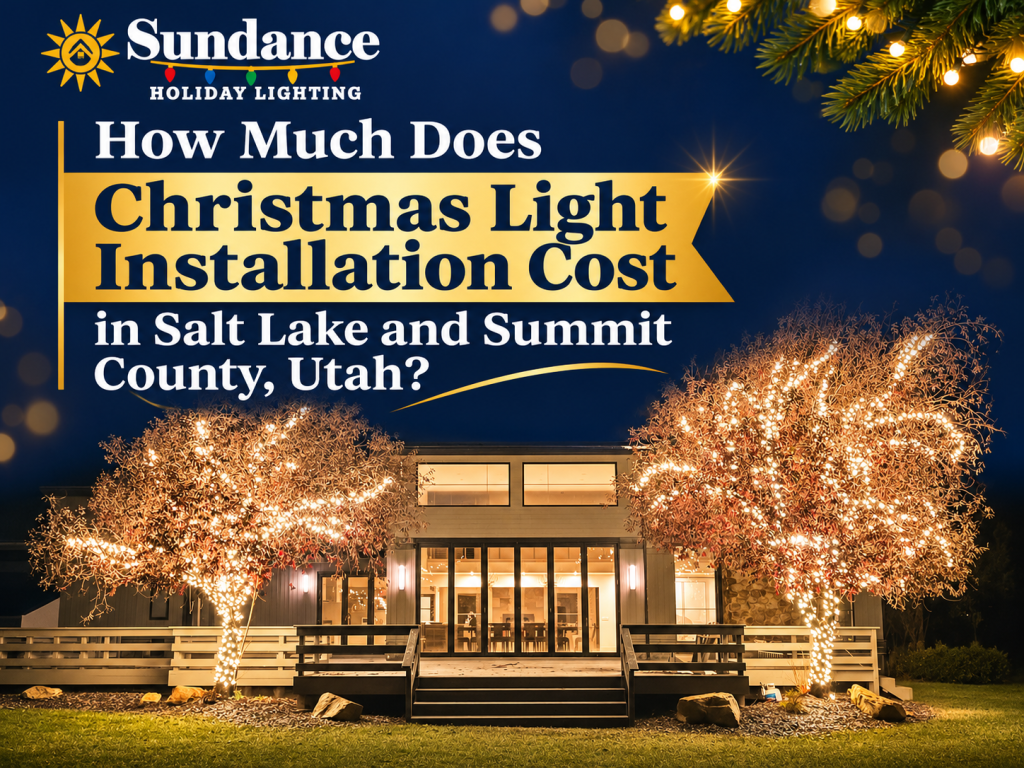
How Much Does Christmas Light Installation Cost in Salt Lake and Summit County?
Our displays start at $1,200, and the final price comes from four things: your roofline length, the number and size of your trees, the design you choose, and how accessible your home is. We quote every display individually after we look at your property, so you don’t pay for a package that doesn’t fit your home.
Most of the time, we can assess the outside of your home and send you a proposed design without you being there, at least for roofline displays. For tree lighting, a few photos help us prepare, and we may still visit on site. You see a rendering of your display along with the estimate, so the scope and the price arrive together, and nothing is a surprise.
To reserve your install date, we take a 50% deposit, and the balance is due at installation. The starting price is the same across our whole service area, so your quote reflects your display, not your ZIP code.
Here is how our pricing compares to the numbers you will find online and what each one actually buys.
Table 1: What Christmas Light Installation Costs Around Salt Lake, and What Each Price Covers
| Pricing source | Typical price | What it usually covers | Who owns the lights |
|---|---|---|---|
| National cost guides | $220 to $684, about $444 average | Installation for an average display; lights may or may not be included | Varies |
| Salt Lake City “add or remove” listings | About $262 average, $80 to $600 | Mostly labor to hang or take down lights you already own | Usually you |
| Local full-service packages, first year | $800 to $1,800 one-story; $1,500 to $3,500 two-story | Lights, installation, takedown, storage | Depends on the company |
| Sundance Holiday Lighting | $1,200+ | Design rendering, leased lights, installation, in-season maintenance, takedown, labeled storage | Our lighting program (leased) |
Why Do Online Christmas Light Estimates Look So Much Lower?
The low numbers you see online almost always leave something out. A $262 listing usually means labor only, where you have already bought the lights, and you handle storage yourself. Our price is a full-service lease, so it includes parts of the job those estimates skip.
Labor-only pricing versus a full-service lease
Every light we install comes from our own inventory through our holiday lighting lease program, so we don’t install customer-owned lights. That is a real difference in what you are paying for. A lease means there is nothing for you to buy, nothing to untangle, and nothing to find space for in the garage after the holidays.
We handle everything. We supply the lights, install them, service them through the season, take them down, and store them in totes labeled with your name, so next year your own set goes right back up.
What’s included in a Sundance Holiday Lighting quote?
Your quote is not just the cost of hanging lights for an afternoon. It covers the design, the lights, repairs during the season, removal, and storage. The table below shows what we include, and it also works as a checklist for comparing any installer’s quote.
Table 2: What Our Price Includes and What to Ask Any Installer
| Part of the service | With Sundance Holiday Lighting | Question to ask any installer |
|---|---|---|
| Lights | Leased from our inventory; nothing to buy | Do I buy the lights or lease them? |
| Design | A rendering of your display, usually sent with the estimate | Will I see the design before I pay? |
| Installation | We install C9 roofline lights and LED strands on trees | Are trees and extra features priced separately? |
| In-season maintenance | We fix covered lighting issues through 5:00 p.m. Mountain Time on December 23 and replace any product that malfunctions | What is covered, and until when? |
| Service calls you cause | A $200 trip fee may apply if the issue is not a product or workmanship problem, like an unplugged display or extra decor plugged in | Are there trip fees? |
| Removal | Included in your price | Is takedown extra? |
| Storage | Your set is packed in totes labeled with your name | Where are my lights stored, and do I get the same set back? |
| Color or theme changes next year | Based on current inventory; special-order colors or large roofline changes may add cost, and we tell you up front | What does a color change cost? |
With hundreds of bulbs on a display, we can’t promise every single one will stay lit all season, but we fix what goes out, and that in-season service is included in the price.
What Affects the Price of Your Holiday Lighting Display?
Four things set your quote: roofline length, trees, design, and access. The more roofline we cover, the more C9 lights and install time your display takes. Each tree is wrapped with LED strands, so taller and fuller trees add to the total. A detailed, multi-level design with accent colors takes more planning and labor than a single clean line along the eaves. And a steep roof or a hard-to-reach peak slows the work and affects how we keep our crew safe.
Table 3: Price Factors on the Wasatch Front and Back
| Price factor | Why it changes your quote | What we often see locally |
|---|---|---|
| Roofline length | More linear feet means more C9 lights and more install time | Salt Lake Valley homes tend to have shorter, simpler rooflines |
| Number and size of trees | Each tree is wrapped with LED strands; taller, fuller trees take more | Park City and Snyderville Basin properties often have more mature evergreens |
| Design | Multiple roof levels, accents, and color choices add planning and labor | Larger custom mountain homes usually call for more detailed designs |
| Access | Steep pitches, tall peaks, and snowy or tight access slow the work | Heavier snow on the Wasatch Back makes access a bigger factor late in the season |
| Extra features | Gutters, railings, and similar features are reviewed case by case | Mention them at your estimate so they are in your quote |
A first-year install also takes longer than a return visit, because our technicians measure and cut each line to fit and screw in individual bulbs so your display looks custom to your home.
We light rooflines and trees. If you’d like to include gutters, railings, or other features, let us know during your estimate so we can review the layout and access. It is not a problem; it is just not part of a standard display, so we want it in the quote from the start.
Salt Lake Valley vs. Summit County: Why Mountain Displays Often Cost More
Your quote reflects the size and design of your display, and mountain displays often cost more because homes and properties are larger. Summit County has the highest home prices in Utah, with a median sale price around $2.2 million in early 2026, while a typical Salt Lake County home is valued closer to $568,000. That gap shows up in the lighting too: larger custom homes on the Wasatch Back usually mean more roofline, more mature trees, and more detailed designs than a smaller valley home.
Snow is the other difference. Park City averages about 140 inches of snow a year in town, more than double what the Salt Lake airport sees. Heavier snow makes roof access harder later in the season and pushes takedown toward spring, which is why booking early matters more the higher up you live.
Holiday lighting rules in Park City and Summit County
Where you live also sets when your lights can be on. In Park City limits, seasonal lights are allowed from November 1 through March 1, and residential lights need to be off by 11:00 p.m. In unincorporated Summit County, including the Snyderville Basin, seasonal lights can be illuminated from November 15 through March 1, as long as they do not create dangerous glare. You can read the county’s current rules on the Summit County Dark Skies page.
Other towns and HOAs can set their own rules, so it is worth checking before your display goes up. We talk through your area’s dates with you during the estimate so your display is planned around them from the start.
How Our Three-Year Program Lowers Your Cost
Our three-year program offers full pricing in the first year, 10% off in the second year, and 20% off in the third year, subject to your agreement. Because we store your labeled set and bring it back each season, most of our customers choose this option, and it is the one we usually recommend.
Here is how the math works on a display quoted at $1,200. The same percentages apply to whatever your display is quoted at.
Table 4: Three-Year Program Example (display quoted at $1,200)
| Season | Discount | Example price |
|---|---|---|
| Year 1 | Full price | $1,200 |
| Year 2 | 10% off | $1,080 |
| Year 3 | 20% off | $960 |
| Three-year total | $3,240 |
That is $360 less than paying full price for three seasons. One- and two-year agreements are also available if you would rather start shorter.
Is Professional Christmas Light Installation Worth the Cost?
Doing it yourself costs less in dollars, so the honest question is what you get for the higher price. You get your time back, skip the ladder, never store a bin of lights, and get a designed display instead of whatever reaches the outlet.
Safety is a real part of it here. The Consumer Product Safety Commission estimates about 160 holiday decorating injuries a day during the season, nearly half of them from falls, with roughly 14,900 people treated in emergency rooms in a single holiday season. You can see the full holiday safety data from the CPSC. Add an icy Utah roofline to the mix, and the risk climbs.
Safety comes first for us too. Snow, ice, wind, and unsafe access can affect our schedule, and if your roof is buried in snow, we’ll hold off until it’s safe to work. The same team that walks your property for the estimate stays with your project through installation, so you are working with people who know your home, not a rotating crew.
How Booking and Payment Work
Booking is a short, five-step process that ends with your lights up before the holidays.
Reach Out
Reach out with your property address so we can confirm we serve your neighborhood.
Property Assessment
We assess the exterior for your estimate. For most roofline displays, you don’t need to be home, and photos help for trees, though we may still visit.
See Your Design
We send a rendering along with an estimate that explains the scope and the pricing.
Approve and Schedule
Choose your agreement length; most customers choose the three-year program, and place a 50% deposit to reserve your date.
Installation Day
On installation day, we put up your display, and the remaining balance is due.
We start installing on October 1, and our install season typically runs through December 18, weather permitting. Once heavy snow builds up on a roofline, we won't send a crew up there, so booking early is the best way to get your display up. Booking earlier also gives you more dates to choose from, and our existing customers get scheduling priority, so the calendar fills quickly closer to the holidays.
Frequently Asked Questions
Everything you need to know for a brighter holiday season
Can you install Christmas lights I already own?
No. Every light we install comes from our own inventory through our holiday lighting lease program. The upside for you is that there is nothing to buy up front and nothing to replace when a strand wears out, because keeping the lights working is on us.
Is there a warranty on the lights?
Coverage for the leased lights, maintenance, and repairs is outlined in your holiday lighting agreement, and we review it with you before you book. We replace any product that malfunctions during the season, though with hundreds of bulbs on a display, we can't promise every single one stays lit the whole time.
When do you take the lights down?
We can turn your display off in January, but we usually take it down around March, once roofs, cords, and extension lines are clear of snow. We'll be back on or before March 30 unless your agreement says otherwise, and removal is included in your price, so the ladders and packing are on us.
Can I keep my lights up longer?
Yes. If you want to extend your lease past the usual takedown period, we can do that for a monthly fee, quoted on request.
Do businesses and HOAs pay the same as homeowners?
Commercial clients get commercial pricing, including a lower per-strand price on LED lights, and the three-year savings apply there too, subject to your agreement. We light most types of commercial properties. High-rise buildings are the exception and are outside our scope.
What happens if my lights stop working in December?
Contact our office so we can review the issue and arrange service, and leave the installed lighting and connections in place for our team to inspect. Our in-season maintenance runs through 5:00 p.m. Mountain Time on December 23.
Ready for a Price on Your Display?
The simplest way to get a real number is to let us look at your home. Send us your property address, and for most roofline displays we can assess the exterior without you being there, then send you a rendering and an estimate before you commit to anything. You will see exactly how your home will look and what it costs, with no pressure. Call us at (435) 631-9797 to get started, and we will help you plan a display that fits your home across the Wasatch Front and Back.